During the recent summit of the European Political Community in Yerevan, French President Emmanuel Macron combined his official programme with a state visit. The “special relationship between two sisters”—as Yerevan and Paris call each other—was underscored in many ways: a joint stroll through the city, a morning run around Yerevan, and, finally, a memorable and touching moment when President Macron sang “La Boheme”, the famous song by the renowned French chansonnier of Armenian descent Charles Aznavour, with Prime Minister Nikol Pashinyan accompanying him on drums.
As is well known, “La Bohème” is an ode to Parisian bohemian life, primarily to its street artists. The official video shows from different angles the iconic Sacré-Cœur Basilica atop the Montmartre hill, the equally famous Moulin de la Galette windmill immortalised in works by Renoir, Vincent van Gogh and Pablo Picasso, the atmospheric cobblestone streets in the heart of Montmartre, the Église Saint-Jean-de-Montmartre, and the staircase on Rue Foyatier up which the funicular climbs.
All these corners of Paris, which street artists painted decades ago, still exist and can be seen today. They have survived to this day nearly unchanged, despite wars and political upheavals. As the saying goes, “Paris is always Paris.”
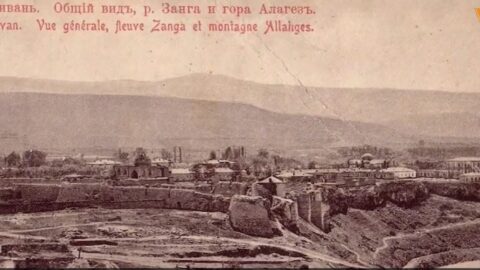
At the same time, in the 19th and early 20th centuries, other artists were also capturing the beautiful views of another city—the present-day capital of Armenia. Back then, however, it was called not Yerevan but Irevan or Erivan, named after Revangulu Khan, who founded it. Paintings and engravings from that era show the fortress, the khan’s palaces, mosque domes and Oriental interiors.
Here is a painting by the remarkable Russian battle painter Franz Rubo, titled “The Capture of the Erivan Fortress”. On the horizon you can see the twin peaks of the Aghri Dagh—the mountain range known in Armenia as Ararat—and a panoramic view of the city, with its mosque domes and minarets.
These paintings were authored by another Russian artist, architect and Prince Grigory Gagarin. His canvas “In the Residence of the Erivan Khan” reveals the sumptuous Oriental interiors of the Erivan khans’ palace. According to contemporaries, it was the most beautiful building in the entire East, with a crystal hall, stained glass and a divan reception room.
Here is an engraving titled “The Storming of the Erivan Fortress” from a Russian military-historical publication of the 1820s–1840s.
Here is a lithograph by battle painter Vladimir Moshkov, “The Storming of the Persian Fortress of Erivan on October 1, 1827”.
And this is a drawing by the French artist Dubois de Montperreux, depicting the harem courtyard of the Erivan Khan.
Here are works by the Russian photographer Dmitry Yermakov. We can see the Crystal Hall of the same palace, its magnificent stained glass…
This photograph is entitled “The Divan Room of the Hall of Mirrors of the Sardar Palace, taken by photographer H. Lynch.
But can all these architectural monuments be seen in present‑day Yerevan, as they can in Paris? Alas, no. The “Oriental fairy tale” of Irevan that once so enchanted artists, photographers and travellers have been removed. No, this is not the result of large‑scale wars or catastrophic earthquakes. The magnificent fortress, the beautiful khan’s palace, six of the city’s seven mosques—all of this was systematically demolished, mainly in the 1960s.
By a bitter twist of fate, it was precisely at that time that Aznavour’s signature song was released. “La Bohème” began to echo through Paris while the city with Azerbaijani heritage known as Irevan was being transformed into the Armenian city of Yerevan.
The entire historical fabric of what is now the modern city of Yerevan was extensively altered.
The prestigious Marriott Hotel, where the French delegation led by President Macron stayed and from where he set out on his morning jog, stands on the site of the very same demolished Irevan fortress. Today, that fortress can only be seen in artists’ paintings and on a medal struck to commemorate the capture of Erivan.
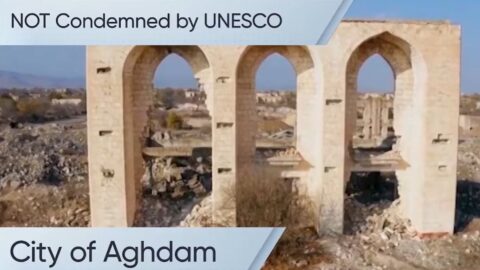
This is the hill where the Sardar’s palace once stood. Here you can see an old photograph. But this one is newer, taken on the site of the khan’s palace, which presently hosts… a brandy plant. It hardly needs underlining that the Erivan khans were Muslims and did not consume alcohol. Yet it is in the cellars of their former home that brandy is produced today. Incidentally, this is what Azerbaijanis saw in the liberated territories in 2020. This building used to be a mosque. Look at how they used it in absolutely inappropriate ways. A parallel with the brandy distillery is hard to avoid, isn’t it?
These are the remains of one of the mosques on Tepebashi Hill, since renamed Kond. The Yerevan municipality now plans to “redevelop” this district with the help of French investors. In other words, the plan is to replace remaining traces of the historic construction site. This is what remains of the Abbas Mirza Mosque.
This one is a rare case in world history. Normally, the heritage of others is carefully preserved. After the Reconquista, the Spanish did not demolish the Alhambra Mosque. While at war with Mexico, the Americans preserved Santa Fe, a jewel of Mexican colonial style. Because it mean beauty and history for them.
But Yerevan chose a different path. The historic architecture of Irevan bore too convincing a testimony to the fact that it was a city with a strong Muslim, Azerbaijani architectural heritage.
Therefore, a massive reconstruction of the city was carried out.
Do you know of a single country in the world that radically altered its architectural appearance, demolishing medieval Muslim architecture and building new Christian architecture on its ruins? It is also a rare example of a sweeping change of around two thousand place names, including those of rivers and lakes, were renamed from their historical Azerbaijani names to newly invented Armenian ones.
Of course, President Macron has no idea that he took a stroll through the ruins of history and an open‑air archive of demolished heritage.