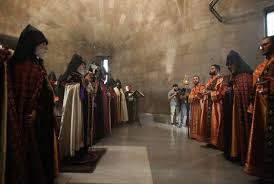
It is often said that Armenia is “one of the oldest Christian countries.” And this is quite true. However, this statement refers to the territory, not the people.
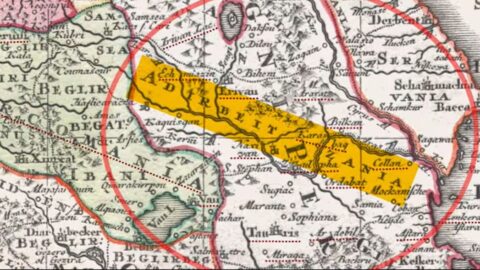
The term “Greater Armenia” is also often mentioned. This was an ancient geographical region that has no relation to the modern state of Armenia. If you look at old European dictionaries from the 16th to 18th centuries, the word “Armenians” referred to all people living in this region, regardless of their religion. Even the Muslims who lived there were often called Armenians!
Armenian researcher and historian Philip Ekozyantz responded to this statement in a Facebook post.
The historian does not dispute that the Christian tradition is linked to the territory of Armenia. But he adds that today Armenians “mistakenly consider themselves the only descendants of those first Christians of Armenia, and the Republic of Armenia the heir to the entire territory of the Armenian Highlands, which was called “Greater Armenia.”
To understand “why it is mistaken,” the historian suggests answering two questions:
First question: what is Greater Armenia (or Armenia Major), where, according to ancient texts, the first Christians spread their faith?
Greater Armenia is a physical and geographical region whose boundaries did not change throughout all known history, because they were not political but natural. Political (or state) borders, as is well known, changed after almost every war. Thus, the state of Armenia that exists today cannot be the heir to a vast natural region simply because their names coincide. It is very important to understand that Greater Armenia and the state of Armenia are two completely different concepts.
Second question: whom were called Armenians?
The earliest explanatory dictionaries that have come down to us and answer this question date back to the 16th–17th centuries. They state that Armenians are the inhabitants of Armenia — not a state, since no such state existed at that time, but the natural region of Greater Armenia.
In both editions of “Onomasticon propriorum nominum” by Konrad Gessner, published in 1544 and 1551, we read that “Armenians are a people who reside in this region (in Armenia).”
In the “Universal Historical-Geographical Dictionary” (“Lexicon Universale Historico Geographico”) by Johann Jacob Hofmann, published in 1698, we can read that “Armenians are the people inhabiting Armenia.”
In the “Universal Geographical Dictionary” (“Dictionnaire Geographique Universel”) published in 1750, we read that “Armenians is properly the name of the peoples of Greater Armenia” (“Arméniens – c’est proprement le nom des peuples de la Grande Arménie”).
In Encyclopedic Dictionary “The New Larousse for All” (“Le Larousse pour tous nouveau: dictionnaire encyclopédique”) from 1907-1910, we read that “An Armenian is one who is from Armenia.”
In the 17th century, the term “Armenians” acquired another meaning — it began to be used to denote a Christian sect that preached on the territory of the Armenian Highlands.
In the theological, historical and chronological dictionary of Jacques de Juigné-Broissinière, published in 1644, there is an entry on ‘Armenians’ and it follows the entry on ‘Armenia,’ where its borders completely coincide with the borders of the Armenian Highlands. Dictionnaire théologique, historique… / Juigné-Broissinière, 1644
“Armenians are the peoples of this great country of Armenia, who for the most part are subjects of the Great Sultan… As for religion, most Armenians are Mohammedans. However, there are many Christians here belonging to a sect called “Armenians.”
Note that the medieval author states that the majority of Armenians are Muslims.
However, today Armenians will tell you that they have never been Muslims! And this fact is precisely the starting point for unraveling this confusion, which historical falsifiers exploit to attribute the historical and cultural heritage of the “Great Armenia” region exclusively to today’s Armenians, …who identify themselves as Hays and call their country not Armenia but Hayastan.
Whenever the term “Armenians” appears in historical documents, modern Armenians interpret this as proof of their ancient origin as a nation. This misleads both the residents of Armenia itself and the entire global public.
However, as we can see, historical documents refer precisely to the inhabitants of the “Armenia” region, among whom, of course, there could also have been Hays. The Hays lived on these lands alongside other peoples, and all of them were ancient, and all of them together were called “Armenians.”
The fact that Armenians previously referred to all inhabitants of Greater Armenia without exception is also confirmed by the works of Armenian authors.
Arakel of Tabriz, describing the resettlement of Armenians by Shah Abbas deep into Persia (the Safavid state), writes:
“Therefore, he ordered the relocation of all inhabitants of Armenia — Christians, Jews, and Mohammedans — to Persia…”
“The Shah ordered, under the threat of the sword, death, and captivity, that the inhabitants of Hayastan be expelled from everywhere they could be reached, driven out and not a single living soul left behind, whether Christian or Mohammedan.”
Thus, Ekozyantz concludes that the actual transformation of Armenians from the entire population of Greater Armenia into an exclusively Christian community occurred at the time when Rome and the Christian rulers of Europe decided to create an internal opposition within the Ottoman Empire that would oppose the Great Sultan and at the same time be easily controlled from Rome.
To solve this task, they chose the Christian community on the territory of Greater Armenia, transformed it into a separate people, and endowed this people with an ancient history that in reality did not belong exclusively to them.
Sources and evidence references:
- Konrad Gessner’s Onomasticon Propriorum Nominum (1544, 1551 editions)
- Johann Jacob Hofmann’s Lexicon Universale Historico Geographico (1698)
- Dictionnaire Geographique Universel (1750)
- Le Larousse pour tous nouveau (1907–1910)
- Jacques de Juigné-Broissinière’s theological dictionary (1644)
- Arakel of Tabriz’s chronicles on Shah Abbas’ resettlement
- Philip Ekozyantz’s historical analysis (referenced with source verification)