Armenia regularly accuses Azerbaijan of “erasing” or “rewriting” history, especially in Karabakh. But what happens when these claims are checked against archives, expert opinions, and international law? In this video, Fuad Akhundov and other researchers walk through concrete examples—from Shusha to Georgian and Caucasian Albanian monuments—showing who has really been distorting inscriptions, re-labeling churches, and destroying historical artefacts in the South Caucasus.
In 1978, in Karabakh there was installed the Maragha-150 monument dedicated to the 150th anniversary of Armenians’ resettlement from Maragha in present-day Iran to the lands of Karabakh. Ten years later, in 1988, as soon as the Armenians of Karabakh declared their intention to join these lands to Armenia and with the beginning of the Armenian-Azerbaijani conflict over Karabakh, the inscription was erased from the monument. Indeed, the process of altering historical monuments by Armenians in the South Caucasus, which hosts the territories of present-day Armenia, Azerbaijan and Georgia, dates back to 1828 with the start of mass resettlement of Armenians to the region. They began immediately Armenianising Albanian monuments in what is now Azerbaijan and Armenia, as well as Georgian monuments in present-day Georgia. Armenia not only erased the Azerbaijani cultural heritage, it actually completely changed its appearance. And this is best illustrated by the example of the center of Yerevan, in which, starting from the middle of the last century, all Azerbaijani (Muslim) traces were completely destroyed, and the Armenian-Soviet face of the capital of Armenia was created. Now Armenia is the only mono-ethnic country in the highly multi-ethnic Caucasus region, which is not the result of a natural process but a planned ethnic and cultural erasure. Nowadays Armenia is actually an open-air museum of vandalism.
There is considerable evidence of the algorithm Armenians have used to alter historical and religious sites in Azerbaijan and Georgia. For example, here is a quote from the book «Armenian Scholars and Crying Stones», 1902, by the prominent Georgian public figure Ilya Chavchavadze: “There are many examples of Armenians trying to erase and destroy the traces of Georgian origin on Georgian churches and monasteries, scraping or erasing Georgian inscriptions from stones, plucking the stones out of buildings and replacing them with those bearing Armenian inscriptions.”
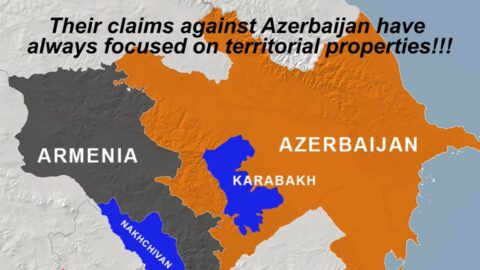
This is a very important evidence, as it proves how Armenians had prepared ground for their territorial claims! So, with the inception of three independent states in the South Caucasus according to the Treaty of Versailles, i.e. Azerbaijan, Armenia and Georgia, Armenia has immediately raised territorial claims against Azerbaijan over Nakhchivan and Garabagh, as well as against Georgia over Akhalkalaki and Borchaly. In fact, Yerevan continues to claim the Georgian lands, albeit in a mothballed form. Otherwise, a territorial dispute between Armenia and Georgia would prevent Armenians from promoting their main slogan about the Karabakh conflict, that is—presenting it as a Muslim-Christian conflict.
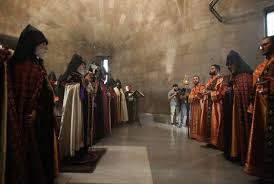
Yet sometimes Armenians cannot bridle their ambitions in this direction either. Just a few years ago the Armenian Church officially requested the Georgian government to transfer 442 Georgian churches to it on grounds of them being Armenian ones. Head of the Georgian Diocese of the Armenian Church, bishop Vazgen Mirzakhanyan, in his letter addressed to the Georgian Prime Minister Irakli Garibashvili asked to return to Armenia the “churches, monasteries (both active and non-active), their ruins, as well as the land plots they stand on or are owned by the Georgian Diocese of the Armenian Church”. Note the demand for the return of ‘land plots’, which cover an area of dozens of square kilometres and are located on the Georgian territories of Akhalkalaki and Javakheti, which Armenia has claimed for a century!
Also it is very easy to see parallels with Ilya Chavchavadze’s warning about Armenians erasing Georgian stone inscriptions and replacing them with Armenian ones. By the way, Russian scientist Nikolai Shavrov, who was directly involved in the colonisation process back in the 19th-early 20th centuries, wrote about the same algorithm too.
Armenian falsifiers have not changed their methods even a hundred years later. During the liberation of Karabakh, a laboratory discovered in the Kelbajar district was full of allegedly Armenian stone crosses. In fact, they had been artificially aged using a mixture of apple vinegar and various chemicals. After the chemical treatment, they had been buried in the ground for some time—before getting unearthed and presented as ‘ancient’ Armenian khachkar crosses.
In fact, Armenian alchemists have been known to perform similar ‘miracles’ since the 19th century, albeit using organic staff such as dung and moulds. A mention of this can be found in the letter of the Metropolitan of Bethlehem to the Archimandrite Porphyry Uspensky, a famous scholar specialised in Hellenic literature.
Boris Piotrovsky, a prominent Soviet scholar and orientalist spoke in detail about how Armenians misrepresented Azerbaijani and Arabic coins and inscriptions as supposedly ancient Armenian ones.
There are many photographs showing how the monuments and buildings in Karabakh looked before and after the ‘Armenian manipulation’. Forexample (see: photos), they took an 18th century administrative building and successively transformed it into an ancient Armenian church. First, they made the appropriate interior decoration, then they cleared the area around the building to prepare it for a so-called ancient cemetery, which housed a bunch of tombstones brought from all over the country, then they attached a bell tower, and now we have an ancient Armenian church… That’s exactly how the Armenians have created the ‘ancient’ Armenian city of Tigranakert in the Aghdam district of Azerbaijan.