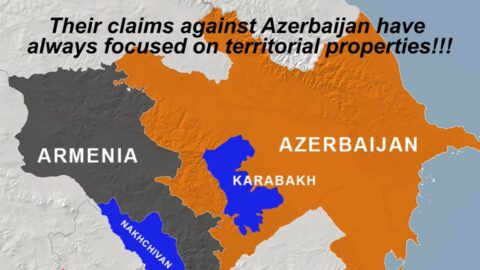
 Up until the mid-19th century, the territory hosting present-day Armenia was referred to as Azerbaijan. It was, in fact, part of the greater historical region of Azerbaijan. Back in the 18th century, the Russian officer and imperial envoy to Georgia, S. D. Burnashev, made references to the “Ardibizhanian cities of Erivan and Ganja along with their surrounding lands”.
In his reports to the Russian Tsar, Burnashev made notes on Azerbaijan, its ten khanates, and Georgia, two distinct regions in the South Caucasus. In a decree dated June 12, 1724, Peter the Great mentioned: “Karabagh, Ganja, Erivan, Nakhichevan, and other Ardibijanian provinces”.
In a 1727 decree, Russian Emperor Peter II mentioned “the entire territory between the Kura and Araks rivers, namely all of Adirbizhan”.
And here is a passage from a 1799 decree by Russian Emperor Paul I addressed to the State Collegium of Foreign Affairs: “Aderbaijan is a region bordering the Ottoman Porte and governed by individual Khans, such as the Khans of Ganja, Erivan, Khoy, Karabagh, Tabriz and others…”
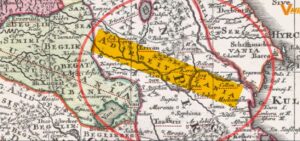
That is to say that Russian rulers referred to the territories that now form modern Armenia as part of Azerbaijan. It’s reasonable to suggest that the term “Azerbaijan” hadn’t yet been formalized in the Russian language at the time, but its use is still clearly recognizable, and it certainly bears no resemblance to the term “Armenia”. This is further supported by Russian, British, German, and other historical maps.
For example, maps from the 18th and early 19th centuries label the area that is now Armenia as part of Azerbaijan. This is a verifiable historical fact. Until the first quarter of the 19th century, 10 Azerbaijani khanates existed within what is now modern Azerbaijan and Armenia, including Baku, Ganja, Karabagh, Erivan, and Nakhchivan.
These khanates eventually came under the control of the Russian Empire, either through military or diplomatic means. After the signing of the Turkmanchai Treaty in 1828, Russia began resettling ethnic Armenians from the Ottoman and Persian Empires into the Erivan and Karabakh khanates of Azerbaijan, in an effort to establish a so-called Christian outpost. Nicholas I even attempted to establish an Armenian province in the area, but the plan was abandoned in 1840. Meanwhile, the resettlement continued, with the Armenian population on Azerbaijani lands increasing amid the planned expulsion of Azerbaijani residents.
As a result, in 1918, it was possible to declare an independent Armenian Republic in the South Caucasus, which would later become the Armenian Soviet Socialist Republic as part of the Soviet Union. Just as the terms “Northern Azerbaijan” and “Southern Azerbaijan” became necessary following Azerbaijan’s division in accordance with the Gulustan and Turkmanchai treaties. A new term, “Western Azerbaijan”, was coined to describe the newly formed Armenian state, haphazardly established on the lands of the former Erivan Khanate. Before the emergence of Armenia, there was no need to use this term, as Azerbaijan had historically existed as a unified entity, without Eastern or Western distinctions.
Here is another important reminder. The historical architecture of modern-day Yerevan, which could have served as a clear evidence of its Azerbaijani past, has been completely destroyed. All historical geographical names have been erased from Armenian maps, such that the Zanga River became Razdan, Arpachai became Akhurian, the Goycha Lake became Sevan.
Remarkably, Armenia remains the only post-Soviet republic to reject the restoration of historical place names simply because of their Turkic origin. A few years ago, a scandal erupted in Armenia when it was discovered that the cities of Stepanovan and Spitak were referred to by their Turkic names in Armenian history textbooks, Jalaloghlu and Hamamly, respectively. The incident sparked public outrage in the country. How could Armenian textbooks include Turkic geographical names? Current Armenian Prime Minister Nikol Pashinyan follows the same route, expressing astonishment when President Ilham Aliyev refers to Armenia as Western Azerbaijan.
We would like to remind the Armenian Prime Minister that not only the head of Azerbaijan, but also other state leaders, had for centuries referred to the territory of modern Armenia as Azerbaijan or Azerbaijani khanates.” Yerevan pursues a policy rooted in aggression and plans to occupy the territories of neighboring states, thereby denying its own people access to historical truth. This is why Armenia, contrary to Pashinyan’s claims of being a beacon of peace, represents a deadlock.
You May Also Like


First Maps, Then Mosques, Then People…
04/11/2025

Secrets of Yerevan: The Lost Fortress
28/04/2025
Kocharyan: a silly man or a liar?
16/01/2025