Recently, a video footage showing the meeting between Levon Ter-Petrosyan, the first president of Armenia, and Yerkrapah militants emerged on social media.
The event took place back in 1993. During the meeting, Ter-Petrosyan, serving as the head of state at the time, refers to the expulsion of Azerbaijanis from Armenia as “the centuries-old dream of the Armenian people”. He then proceeds to congratulate the audience on the capture of Aghdam, a city that would later earn the grim nickname “Hiroshima of the Caucasus” due to the extensive destruction caused by Armenians.
What the first president of Armenia referred to as “the centuries-old dream of the Armenian people” has a clear and unequivocal definition on the international law: genocide, the genocide of the Azerbaijani people. This is also the reason why Armenia stands as the only mono-ethnic state in the Caucasus, a region otherwise characterized by its remarkable ethnic diversity. Armenia is surrounded by four multi-ethnic states: Azerbaijan, Georgia, Turkey, and Iran in a region known worldwide for its intricate political and cultural landscape. A region where even neighboring villages often speak entirely different languages.
Therefore, it becomes evident that Armenia’s mono-ethnicity cannot be attributed to natural evolutionary processes. Instead, it is the direct outcome of systematic ethnic cleansing.
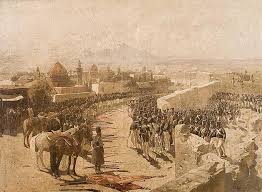
This process traces its roots back to the early 19th century, when the South Caucasus was under the control of the Russian Empire. Beginning in 1828, Tsarist Russia initiated the resettlement of Armenians into the region, a policy that continued until 1918, when Armenia gained independence.
The displacement of the local Azerbaijani population by Armenians was initiated and documented by Alexander Griboyedov, a Russian playwright and diplomat, who noted that Armenians began to push out Azerbaijanis from lands historically owned by Muslim landowners.
This marked the transformation of the Azerbaijani Yerevan Khanate into what is now known as Armenia.
Armenian scholar Zaven Korkodyan highlighted that according to 1916 statistical data, 373,582 Azerbaijanis lived in the Yerevan province of the Russian Empire. However, by the time Soviet rule was established in late 1920, fewer than 10,000 Azerbaijanis remained. The genocide of Azerbaijanis between 1918 and 1920 resulted in the deaths of approximately 130,000 Azerbaijanis and forced around 240,000 to become refugees, all within just two years.
This was the brutal path through which Armenia achieved its mono-ethnic status – through genocide and ethnic cleansing.
During Armenia’s brief period of independence from 1918 to 1920 under the Dashnak government, this process reached its peak, marked by extreme barbarity and unprecedented cruelty.
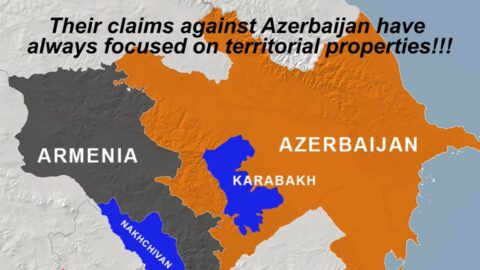
It’s also worth noting that immediately after gaining independence in 1918, Armenia declared war on both Azerbaijan and Georgia, laying territorial claims to Karabakh and Nakhchivan in Azerbaijan and Akalkalaki and Borchali in Georgia.
This period also saw the rise of figures like Garegin Nzhdeh, the founder of Tseghakronism and a collaborator with fascist regimes. As well as Drastamat Kanayan, known as Dro, and General Andranik Ozanian, who orchestrated large-scale ethnic cleansing of the Azerbaijani population. Their actions are depicted shamelessly in the contemporary feature film “Garegin Nzhdeh”, where Nzhdeh is shown declaring his intention to liberate 200 villages, a euphemism for the expulsion of the peaceful Azerbaijani population. Today, these individuals are celebrated as national heroes in Armenia.
The Soviet era saw further displacement of Azerbaijanis from Armenia through Joseph Stalin’s Decrees of 1947-1948, which mandated their deportation to Azerbaijan. Eyewitness accounts from this period have been preserved, shedding light on the suffering endured by the Azerbaijani population. The final phase of this systematic expulsion took place in November 1988, when over 200,000 Azerbaijanis were forced to flee Armenia. This wave of violence was triggered after the Supreme Council or Parliament of Azerbaijan proposed granting Azerbaijanis living in Armenia the same autonomous status that Armenians enjoyed in Azerbaijan. In response, Azerbaijanis across Armenia were subjected to killings and mass expulsions. A total of 242 Azerbaijanis were killed. Within three weeks, not a single Azerbaijani remained in the country. A survey conducted among Western Azerbaijanis revealed that 93.1% of respondents were forced to leave their ancestral lands due to the ethnic cleansing policies of the Armenian government. Nearly all were displaced in 1988, when the campaign of ethnic cleansing reached its peak. Only 0.7% had relocated voluntarily before 1988.
Armenians were resettled in areas previously inhabited by Azerbaijanis, effectively erasing the Azerbaijani presence from the region. This is the historical context behind Armenia’s mono-ethnic status, a reality that Levon Ter-Petrosyan acknowledged during his meeting with Yerkrapah militants when he described the expulsion of Azerbaijanis as “the centuries-old dream of the Armenian people”.