It appears that something is not quite right with Alexander Bastrykin, the head of Russia’s Investigative Committee. Otherwise, it is hard to explain what has been leaking to the media regarding the termination of the criminal case into the crash of an AZAL Embraer E190 passenger flight that was flying the Baku–Grozny route on December 25, 2024.
This is how political scientist Fuad Akhundov commented on the contents of a letter from Russia’s Investigative Committee to the Prosecutor General’s Office of Azerbaijan. A copy of this letter was sent from an anonymous account to the bot of the Telegram channel BT News. It was signed personally by Mr. Bastrykin. In the document, the head of the Investigative Committee explains why the criminal case in Russia regarding the investigation into the causes of the crash of the Azerbaijani aircraft was closed.
Here is the quote: “Due to weather conditions (cloud cover), after two unsuccessful attempts the crew was unable to land at Grozny Airport, decided to proceed to another airport, and, during the approach to land at Aktau Airport at approximately 9:28 a.m. (Moscow time), collided with the ground, which led to the destruction of the aircraft and a fire, as a result of which 38 people died and 29 sustained injuries of varying severity. Following the results of the investigation and on the basis of the totality of the evidence obtained, the criminal case has been closed.”
In theory, one could assume that this letter is a fake. But first, no one has refuted it. And second, Azerbaijan’s Foreign Minister Jeyhun Bayramov said at his year-end press conference that the criminal case had been terminated. This fact was later confirmed by the official spokesperson of Russia’s Foreign Ministry, Maria Zakharova.
So what does this mean?
On the morning of December 25, 2024, an AZAL Embraer E190 operating passenger Flight No. 8243 on the Baku–Grozny route crashed in the vicinity of Aktau, Kazakhstan. In the first days and hours after the disaster, photographs appeared. They show holes in the aircraft’s fuselage from “striking elements” of the warhead of standard air-defense missiles. This is clear evidence that the aircraft was shot down. It then became known that the aircraft’s communications were jammed. After that, there was an “external impact,” after which the aircraft set course for Aktau
In early February 2025, an interim report by Kazakhstan’s Ministry of Transport appeared. It states: “Numerous blind and through penetrations were found in the fuselage, documented through photographs and video recordings. The damage was found in the rear part of the fuselage, the overwhelming majority of it on the vertical and horizontal stabilizers, as well as on the left wing and left engine.” The document also notes: “Information was provided that the damage found in the fuselage of the aircraft was formed as a result of exposure to external objects.”
The findings of the Commission were published as well. The Commission includes representatives of Azerbaijan, Russia, and Brazil, as well as an observer from the International Civil Aviation Organization (ICAO). It concluded that the aircraft’s hydraulic system was damaged as a result of “metal tearing due to contact with solid objects,” and that “the damage to the aircraft was presumably caused by striking elements of the warhead.”
On the anniversary of the tragedy, a new report by Kazakhstan’s Ministry of Transport appeared: “The damage to the aircraft was presumably caused by striking elements of the warhead.”
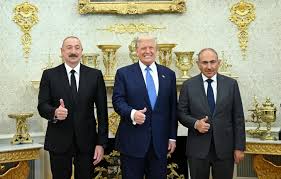
Finally, on October 9, 2025, a meeting took place in Dushanbe between the Presidents of Azerbaijan and Russia, Ilham Aliyev and Vladimir Putin. It was during this meeting that Vladimir Putin literally stated: “…we can talk about the causes of this tragedy, this catastrophe. It is connected with several circumstances. The first is that there was a Ukrainian drone in the sky… The second reason lies in technical malfunctions of Russia’s air-defense system itself. And the two missiles that were launched did not hit the aircraft directly – if that had happened, it would have crashed on the spot – but exploded – perhaps it was self-destruction – a few meters away, roughly about 10 meters. And therefore the damage occurred, but mainly not from combat striking elements, but most likely from fragments of the missiles themselves… Of course, everything required in such cases, in such tragic cases, will be done by the Russian side in terms of compensation, and a legal assessment will be given of the actions of all officials.” That is, he directly acknowledged that the Azerbaijani airliner was hit by Russian air-defense missiles. And he promised that a legal assessment would be given to the actions of Russian officials.
But then Bastrykin suddenly says: the criminal case has been closed! The aircraft could not land due to weather conditions, flew to Aktau, and for some reason crashed there. And not a word about air-defense missiles. As you can see, his words differ from those of Russia’s president and representatives of the Russian intergovernmental commission.
One wonders who this version is meant for. However, later in the letter he says something about appointing a “comprehensive aviation-technical forensic examination,” and that it is “planned to provide an additional assessment of the circumstances of the crash of the aircraft within the framework of a resumed criminal case.” Seriously? First the case is closed, and then it is opened again? In such situations – and Bastrykin knows this well – the case is suspended, not terminated. But Bastrykin clearly wanted to do something unpleasant to Azerbaijan, which has the right to expect the results of investigative actions.
And there is another point. Alexander Bastrykin is supposedly a lawyer. And he should know that a criminal case can be terminated only if there are specific grounds. One of them is, for example, the absence of the elements of a crime. Apparently, the head of the Investigative Committee tried to reduce the issue to exactly that. But the letter provides no grounds. One can build a dozen versions, but most likely, against the backdrop of Ukrainian drone attacks, Russia does not want to anger air-defense officers. How can it be – to put Russian officers on trial at Azerbaijan’s request! But even such an “order” could have been carried out more skillfully, especially after the talks in Dushanbe. Not to mention that 9 Russian citizens also died! Even if they were mostly residents of the North Caucasus, for Bastrykin they are second-class people.
The head of Russia’s Investigative Committee is one of the key figures fueling the country’s anti-migrant campaign. He repeatedly points to what he describes as a rise in migrant crime. But the official court stats tell a different story: from 2013 to 2023, foreigners made up just 4–4,5% of those convicted of crimes in Russia. There is also no major difference between the types of crimes attributed to Russian сitizens and to foreigners.
Meanwhile, some of Bastrykin’s remarks even verge on outright insults.
A video from the St. Petersburg International Legal Forum in 2025 circulated widely online. In it, the head of the Investigative Committee jokes about migrants. During his speech he heard noise in a far corner, stopped, and asked: “What is that, migrants?” The forum guests began laughing, and Bastrykin was told: “Those are Krishnaites.” After that, the head of the Investigative Committee said: “Well, they’re migrants, right? A protest action, Russia will be free!” and raised his fist.
Bastrykin has a special attitude towards the Azerbaijani diaspora. It is enough to recall the dramatic events in Yekaterinburg connected with the Safarov brothers. Or attempts to accuse Azerbaijani students of “extreme views” merely for chanting “yaşasın Azərbaycan!”, which means “Long live Azerbaijan!” Or raids on Azerbaijani weddings in Russia.
It seems the head of the Investigative Committee sincerely believed that with this letter he would humiliate and insult Azerbaijan. In reality, he set up Russia’s president and the Russian state. Because, as a reminder, Vladimir Putin promised on camera to give a legal assessment of the actions of officials. And what now – was the criminal case simply closed? Is that the “legal assessment”? Is the head of the Investigative Committee taking on too much? Clearly, Bastrykin believes he holds a higher position than the President of the Russian Federation.