Now, as Azerbaijan and Armenia are taking steps toward building peace, the Armenian Church and diaspora are once again attempting to sabotage this process.
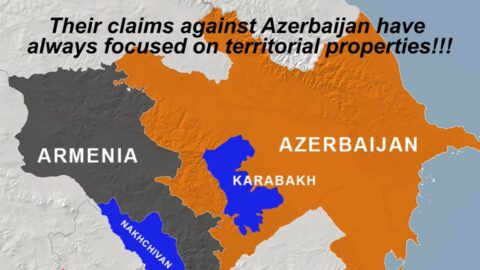
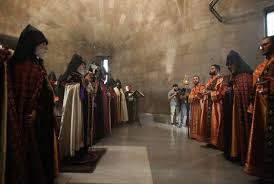
The Armenian clergy supports opposition forces that continue to advance territorial claims against Turkey and Azerbaijan and denounce Prime Minister Nikol Pashinyan’s peace agenda as betrayal and a revision of the core tenets of Armenian identity. The Church maintains close ties with former leaders of the Karabakh junta, Robert Kocharyan and Serzh Sargsyan. Archbishop Bagrat (Galstyan) of the Tavush Diocese has tried to organize protests against the border delimitation process with Azerbaijan. Catholicos Karekin II himself has called for Pashinyan’s resignation.
Thus, the Church is making political statements, interfering in state affairs, and attempting to dictate the direction of foreign policy – even though Armenia is officially a secular state where church and state are separate.
Consequently, as Armenia approaches its 2026 parliamentary elections, the Church’s increasing politicization and shift toward radical opposition is taking on a fateful significance. The country may currently be experiencing one of the most difficult periods in its history.
But to what extent can the Armenian Church truly act as a moral authority and claim to carry out an “exclusive mission in the spiritual life of the Armenian people”?
Indeed, even its very name – “Armenian Apostolic Church” – raises questions among scholars.
There are serious doubts as to whether the Armenian Church can legitimately claim the title “apostolic.” VMedia explored this issue in a documentary titled “Can the Armenian Church Be Called Apostolic?”
Armenian historian Philip Ekozyants presents similar facts in his own video.
Ekozyants points out that local Armenian historians from a relatively late period have tried to convince audiences that the Apostles Saint Bartholomew and Saint Thaddeus preached in Armenia. This legend apparently entered Armenian tradition at a later stage through Greek sources and has become so dominant today that the head of the Armenian Church claims to sit on the “throne of Saint Thaddeus.” In other words, the apostolic origin of the Armenian Church rests on legend rather than documented first-century evidence – as is also the case with many other ancient churches, such as the Roman, Alexandrian, and Antiochian.
Yet even if Thaddeus and Bartholomew did preach in Armenia, that alone would not confer apostolic status upon the Church. Apostolic succession requires an unbroken hierarchical line of episcopal ordinations tracing directly back to Christ’s original apostles – and such continuity does not exist within the Armenian Church.
As Ekozyants notes, the Vatican acknowledges that the history of Christianity in Armenia centers around Saint Gregory the Illuminator and even states that “in him, Armenia had its apostle.” However, Gregory the Illuminator was never an apostle. Thus, the Vatican effectively implies that Gregory served as a kind of “apostle” for the Armenians – and, in a friendly manner, turns a blind eye to the Armenian Church’s self-designation as “apostolic.”
Historically, the more accurate name is the Armenian Gregorian Church – a term that emerged in the 19th century and is linked to Saint Gregory the Illuminator.
Perhaps the Armenian Church should focus on these foundational questions that directly concern its own identity – instead of interfering in state affairs?